
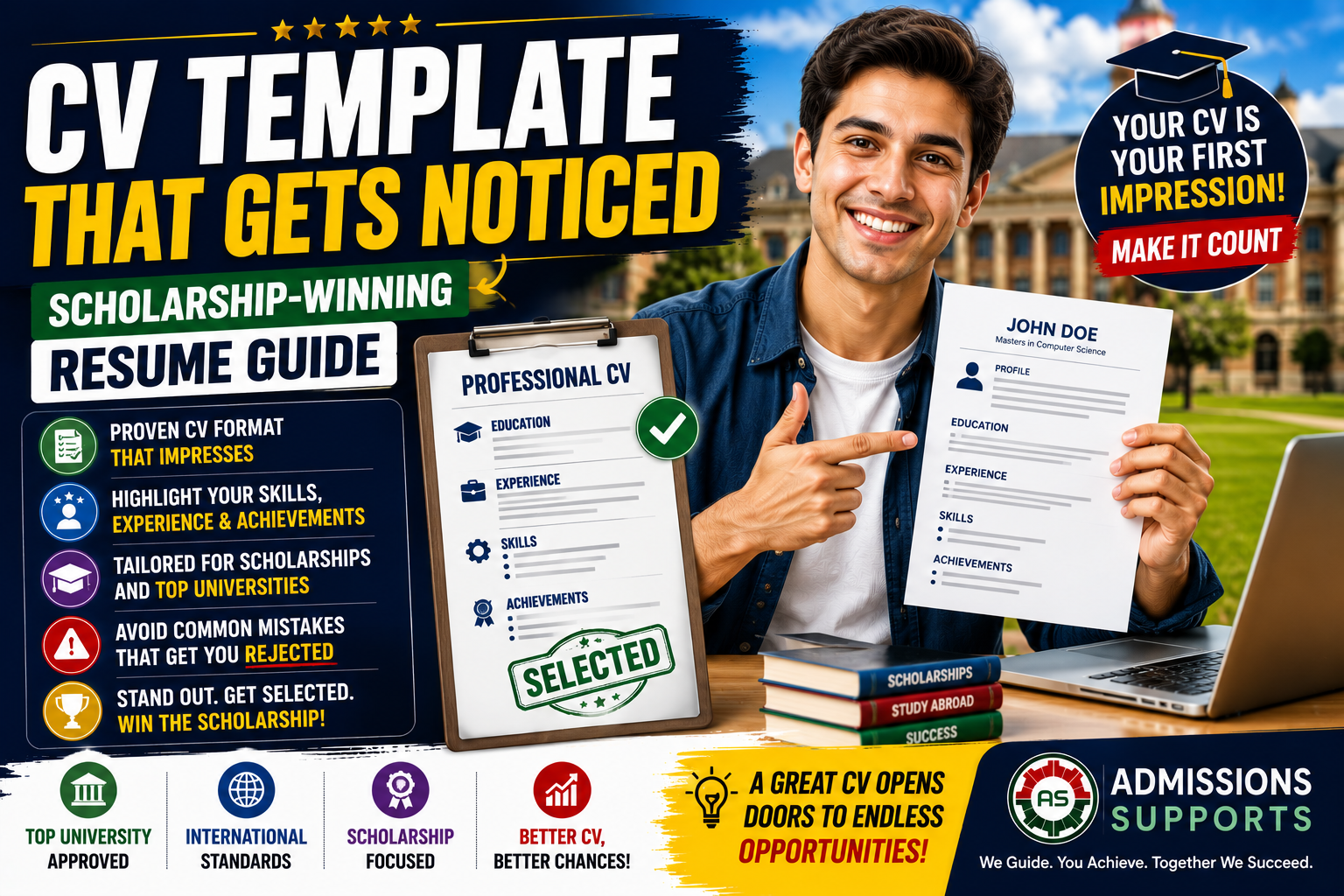
Best CV Format for Scholarship Applications
Overview
A strong CV can significantly improve your scholarship application.
Many students focus heavily on motivation letters and academic transcripts. However, scholarship committees often review CVs first. Therefore, your CV should immediately demonstrate your qualifications, achievements, and potential.
Fortunately, creating a professional scholarship CV does not require advanced design skills. Instead, it requires a clear structure, relevant information, and proper formatting.
In this guide, you will learn:
- What a scholarship CV is
- The best CV structure
- Sections to include
- Common mistakes to avoid
- Expert tips for success
As a result, you will be able to create a CV that stands out among hundreds of applicants.
[INSERT IMAGE 1: Student updating a professional academic CV on a laptop]
What Is a Scholarship CV?
A scholarship CV is a document that summarizes your:
- Academic background
- Work experience
- Leadership activities
- Volunteer work
- Research experience
- Skills and achievements
Unlike a job resume, a scholarship CV focuses more on education, leadership, and academic accomplishments.
Therefore, scholarship providers use it to evaluate whether you are a suitable candidate.
Why Is a Good CV Important?
Scholarship committees often review hundreds or even thousands of applications.
Consequently, they need a quick way to compare candidates.
A well-structured CV helps reviewers understand:
- Your academic strengths
- Leadership abilities
- Community involvement
- Professional experience
- Future potential
Moreover, a professional CV creates a strong first impression.
For this reason, investing time in your CV can greatly increase your chances of success.
Ideal Scholarship CV Structure
A scholarship CV should be easy to read.
Additionally, information should be organized logically.
The recommended structure is:
1. Personal Information
Include:
- Full name
- Email address
- Phone number
- Country of residence
- LinkedIn profile (optional)
However, avoid including unnecessary details such as:
- Religion
- Marital status
- National ID numbers
- Personal photographs (unless requested)
2. Professional Profile
This section is a short summary of who you are.
Keep it between 3–5 sentences.
Example:
“Motivated Environmental Science graduate with strong academic performance and leadership experience. Passionate about sustainability, research, and international development. Seeking scholarship opportunities to further contribute to environmental solutions in developing countries.”
As a result, reviewers immediately understand your background and goals.
3. Education
This is usually one of the most important sections.
Include:
- Degree title
- Institution name
- Graduation date
- GPA (if strong)
- Major achievements
For example:
Bachelor of Science in Computer Science
University of Example
2021–2025
GPA: 3.8/4.0
4. Work Experience
If applicable, include:
- Internships
- Part-time jobs
- Research assistantships
- Volunteer positions
Furthermore, describe achievements rather than duties.
Instead of writing:
“Responsible for data entry.”
Write:
“Managed student database containing over 2,000 records while improving data accuracy.”
Consequently, your experience appears more impactful.
5. Leadership Experience
Many scholarship providers look for future leaders.
Therefore, highlight positions such as:
- Student leader
- Club president
- Team captain
- Event coordinator
- Community organizer
Leadership experience often strengthens scholarship applications significantly.
6. Volunteer Activities
Community service demonstrates initiative and social responsibility.
For example:
- Mentoring students
- Charity projects
- Environmental campaigns
- Youth programs
Additionally, volunteer experience can distinguish applicants with similar academic records.
7. Skills
Include relevant skills such as:
Technical Skills
- Microsoft Office
- Data Analysis
- Programming
- Graphic Design
Soft Skills
- Leadership
- Communication
- Teamwork
- Problem Solving
However, only include skills you genuinely possess.
8. Awards and Achievements
This section showcases excellence.
Include:
- Academic awards
- Competitions
- Scholarships
- Research recognition
- Professional certifications
As a result, scholarship committees can quickly identify your achievements.
9. Research Experience
For Master’s and PhD scholarships, research experience is extremely valuable.
Include:
- Research projects
- Publications
- Conference presentations
- Thesis work
This section is particularly important for:
- [INTERNAL LINK: DAAD Research Grants]
- [INTERNAL LINK: Swiss Government Excellence Scholarship]
- [INTERNAL LINK: Vanier Canada Graduate Scholarship]
Example Scholarship CV Layout
A professional scholarship CV may follow this order:
- Personal Information
- Professional Profile
- Education
- Work Experience
- Leadership Experience
- Volunteer Activities
- Skills
- Awards
- Research Experience
- References
Therefore, reviewers can easily locate important information.
Common Scholarship CV Mistakes
Many applicants reduce their chances because of avoidable errors.
Using Fancy Designs
Scholarship committees prefer simplicity.
Therefore, avoid excessive colors, graphics, and decorative elements.
Including Irrelevant Information
Not every achievement belongs on a scholarship CV.
Instead, focus on information relevant to the scholarship.
Grammar and Spelling Errors
Small mistakes can create a negative impression.
Consequently, proofreading is essential.
Writing Long Paragraphs
CVs should be concise.
Therefore, use bullet points whenever possible.
Providing False Information
Always be honest.
Scholarship providers may verify information during the selection process.
How to Make Your CV Stand Out
Competition is often intense.
Fortunately, several strategies can improve your CV.
Quantify Achievements
Numbers create stronger impact.
For example:
“Led a team of 15 volunteers to organize a literacy campaign reaching 500 students.”
Highlight Leadership
Many scholarships seek future leaders.
Therefore, leadership experience deserves special attention.
Tailor the CV
Different scholarships have different priorities.
Consequently, adjust your CV to align with scholarship objectives.
Keep Formatting Consistent
Use:
- Same font style
- Same font size
- Consistent spacing
- Uniform headings
As a result, your CV appears more professional.
Scholarships That Require Strong CVs
Several prestigious scholarships place significant importance on CV quality.
These include:
- Chevening Scholarship
- Gates Cambridge Scholarship
- Erasmus Mundus Joint Masters
- Fulbright Foreign Student Program
- DAAD EPOS Scholarship
- Australia Awards Scholarship
Therefore, your CV should receive the same attention as your motivation letter.
Scholarship CV vs Job Resume
Although similar, these documents serve different purposes.
| Scholarship CV | Job Resume |
|---|---|
| Academic focus | Employment focus |
| Detailed achievements | Work experience priority |
| Leadership activities | Career achievements |
| Research experience | Professional results |
| Often longer | Usually shorter |
Understanding these differences helps you prepare the right document.
[INSERT IMAGE 2: Scholarship selection committee reviewing CVs]
Frequently Asked Questions
How long should a scholarship CV be?
Most scholarship CVs range from 1–3 pages depending on experience level.
Should I include my GPA?
Yes, especially if your GPA is strong.
Do I need a photo on my CV?
Only if the scholarship specifically requests one.
Is Europass CV accepted?
Yes. Many European scholarships accept Europass CV formats.
Can leadership experience help me win scholarships?
Absolutely. Leadership often plays a major role in scholarship selection.
Final Thoughts
A well-prepared CV can significantly strengthen your scholarship application.
Moreover, it helps scholarship committees understand your academic achievements, leadership abilities, and future potential.
Instead of creating a complicated document, focus on clarity, relevance, and professionalism.
Furthermore, remember to tailor your CV for each scholarship opportunity.
With the right structure and strong content, your CV can become one of the most powerful tools in your scholarship application.
[EMBED YOUTUBE VIDEO: “Best CV Format for Scholarship Applications”]